We adjusted the order of the shoot as the day developed.
That flexibility is one of the advantages of working in partnership with the organisation. The schedule exists to help us achieve the brief, not to make the client’s day more difficult.
A rigid approach might result in the photographer waiting for a planned activity while genuine opportunities are happening elsewhere.
An adaptable approach allows the same four hours to be used much more effectively.
Real activity creates more authentic images
People often feel more comfortable when they have something genuine to do.
Rather than asking colleagues to stand in a room and pretend to work, we can photograph activities that are already part of the organisation’s day.
This may involve a small amount of guidance. We might change the photographer’s position, ask someone to repeat an action or move an unnecessary distraction from the background.
The objective is not to manufacture a false scene. It is to communicate real activity clearly.
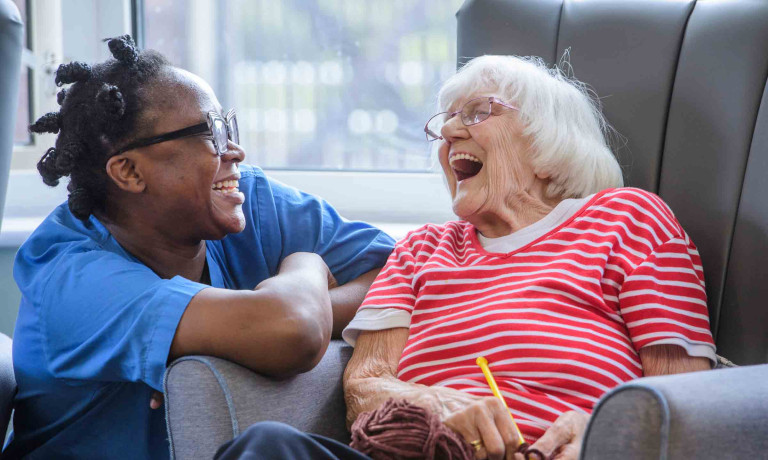
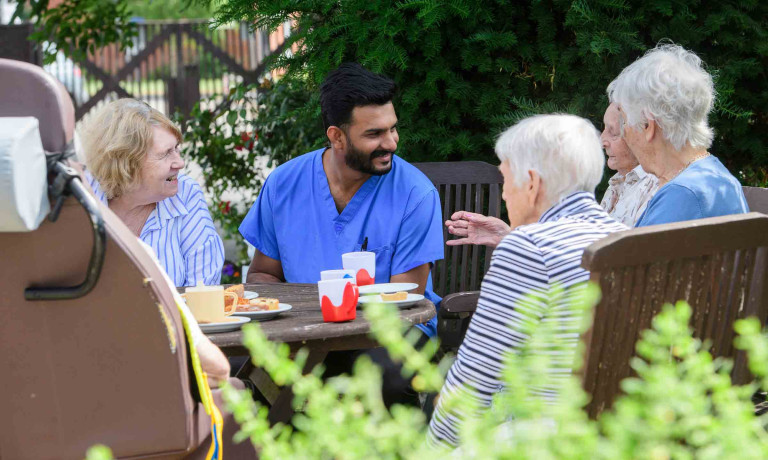
At the care home, photographing conversations, shared activities and everyday interactions helped show the relationships between the residents and care team.
Those images reveal far more about the experience of the home than a sequence of empty rooms could achieve.
They allow prospective residents and their families to see warmth, companionship and attention in action.
That is where commercial photography becomes a meaningful marketing tool. It helps an organisation provide visual evidence of the qualities it wants to communicate.
People are usually the most important part of the story
Buildings and facilities matter, particularly when an organisation has invested in creating welcoming, modern or specialist environments.
But empty rooms rarely explain why someone should trust the people delivering the service.
The care-home team had initially been cautious about how much useful content could be captured. There was a concern that the result might largely consist of wide photographs showing every room.
Our focus was different.
The home itself provided the context, but the people provided the story.
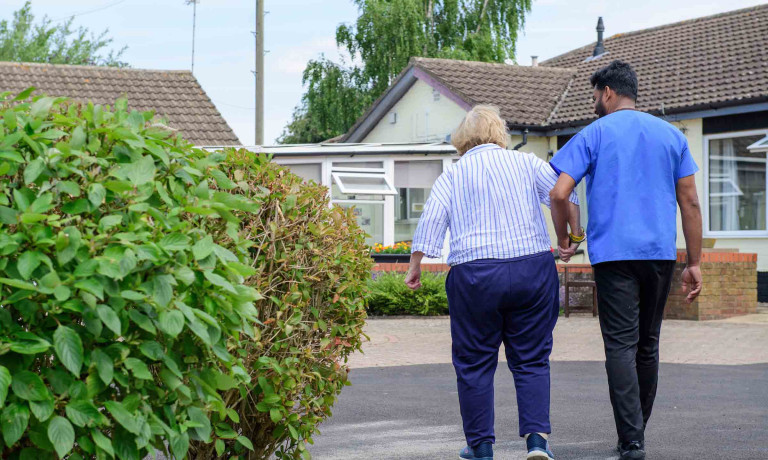
A supportive hand while walking through the grounds can communicate care. A shared laugh can communicate trust and companionship. A conversation between a colleague and several residents can show how people are valued within the home.
These moments are not small additions to the property photography.
They are often the images that explain what makes the organisation distinctive.
This principle extends far beyond the care sector.
A manufacturing organisation is not represented fully by machinery alone. A school is more than its classrooms. A construction company is more than a completed building.
The skills, relationships and human impact behind the organisation are what help audiences form a connection.
The environment still needs attention
Focusing on people does not mean ignoring the surroundings.
Everything visible within a photograph contributes to the impression it creates.
Before and during a shoot, we look for elements that might distract from the intended message, including:
Temporary notices
Outdated posters
Confidential information
Time-sensitive displays
Boxes or equipment that are not normally present
Objects that create unnecessary visual clutter
Signage that no longer reflects the organisation
The care home was still completing parts of a refurbishment, so some areas were not ready to be photographed in full.
Rather than treating that as a problem, we worked with the manager to identify the spaces and angles that represented the home accurately and positively.
We also removed posters and time-sensitive information from walls and windows where they would quickly date the finished images.
This was not about pretending that the refurbishment was complete.
It was about avoiding details that would distract from the real story or unnecessarily limit how long the photographs could be used.
Commercial photography should represent the organisation honestly while giving the marketing team the strongest possible collection from the circumstances available.
Formal photographs can be included without dominating the shoot
Not every image needs to be observational.
A half-day shoot may also include planned requirements such as:
A leadership portrait
A full team photograph
Smaller departmental groups
Colleague profile pictures
A photograph for a press announcement
Key people looking directly at the camera
During the care-home assignment, we included a portrait of the manager and a team photograph alongside the more natural imagery.
The important thing is to plan these requirements around availability.
A team photograph involving several people can take longer to organise than it takes to create. Colleagues may be working in different areas or need to maintain the organisation’s normal service while photography is taking place.
Scheduling the formal images at an agreed time helps avoid repeatedly interrupting people or discovering that an essential colleague has become unavailable.
What can realistically be achieved in four hours?
Every organisation and assignment is different, but a well-planned half-day shoot could include a combination of:
Natural workplace photography
Several teams or operational areas
A leadership portrait
A team photograph
Buildings and facilities
Details that show quality or expertise
A mixture of landscape and portrait compositions
Images for website banners and social media
Recruitment or people-focused photography
A focused process or customer experience
It would not be realistic to expect every one of these requirements across several large locations without making compromises.
Travel, access, gathering people, moving equipment and preparing environments all use part of the available time.
The aim should be to create enough variety to meet the marketing objectives, not to rush through the longest possible list.
A good planning consultation will help identify what belongs in the half-day brief and what may require a longer shoot or a future visit.
The experience should remain positive
Commercial photography often involves people who did not personally choose to be in front of a camera.
Some will feel confident. Others may be apprehensive.
Taking time to explain what is happening and allowing people to remain involved in a genuine activity can make the experience much more comfortable.
Nobody should feel treated as a prop in the organisation’s marketing.
That matters particularly in settings where trust, care and human connection are central to the service. Respecting the people involved is not separate from creating effective photographs. It is part of what makes the photographs feel genuine.
Our purpose is not only to deliver strong images. We also want people to feel relaxed and enjoy the experience as much as possible.
A positive atmosphere helps create better expressions, more natural interactions and photographs that represent the organisation more truthfully.
What happens after the half-day shoot?
Once the photography is complete, the images are reviewed and professionally processed.
The finished collection should offer purposeful variety rather than a large number of near-identical files.
Marketing teams need to be able to choose an image confidently for a homepage, social post, brochure page or recruitment campaign without searching through hundreds of repeated frames.
Our photography packages include commercial usage rights, delivery through a private online gallery and professionally processed images within three working days.
For the care home, the immediate purpose was to update the website. The collection was also planned with longer-term use in mind, including a forthcoming information brochure.
Thinking beyond the first use increases the value of the shoot.
The same image can support several communications, helping the organisation maintain a more consistent and authentic visual identity.
Is a half-day commercial photography shoot right for your organisation?
A half-day shoot can be a strong choice when your organisation:
Has several connected photography requirements
Wants more variety than a focused one-hour session can provide
Is refreshing a website or brochure
Needs to photograph people as well as environments
Has one main location
Can identify clear priorities
Wants to build a reusable marketing image library
The real question is not whether four hours sounds long enough.
It is whether the brief has been planned so those four hours can be used well.
The care-home assignment demonstrated what is possible when the organisation and photographer work together. We responded to live activities, adjusted around operational commitments, worked carefully within partly refurbished surroundings and remained focused on the people and relationships at the heart of the service.
The result was not simply a record of what the care home looked like.
It was a collection designed to show how the home feels.
That is what a successful half-day commercial photography shoot should achieve: purposeful images that help an organisation communicate the things that matter most.
Explore our commercial photography packages, learn more about our business and commercial photography, or schedule a free online consultation to discuss what your organisation could achieve during a half-day shoot.